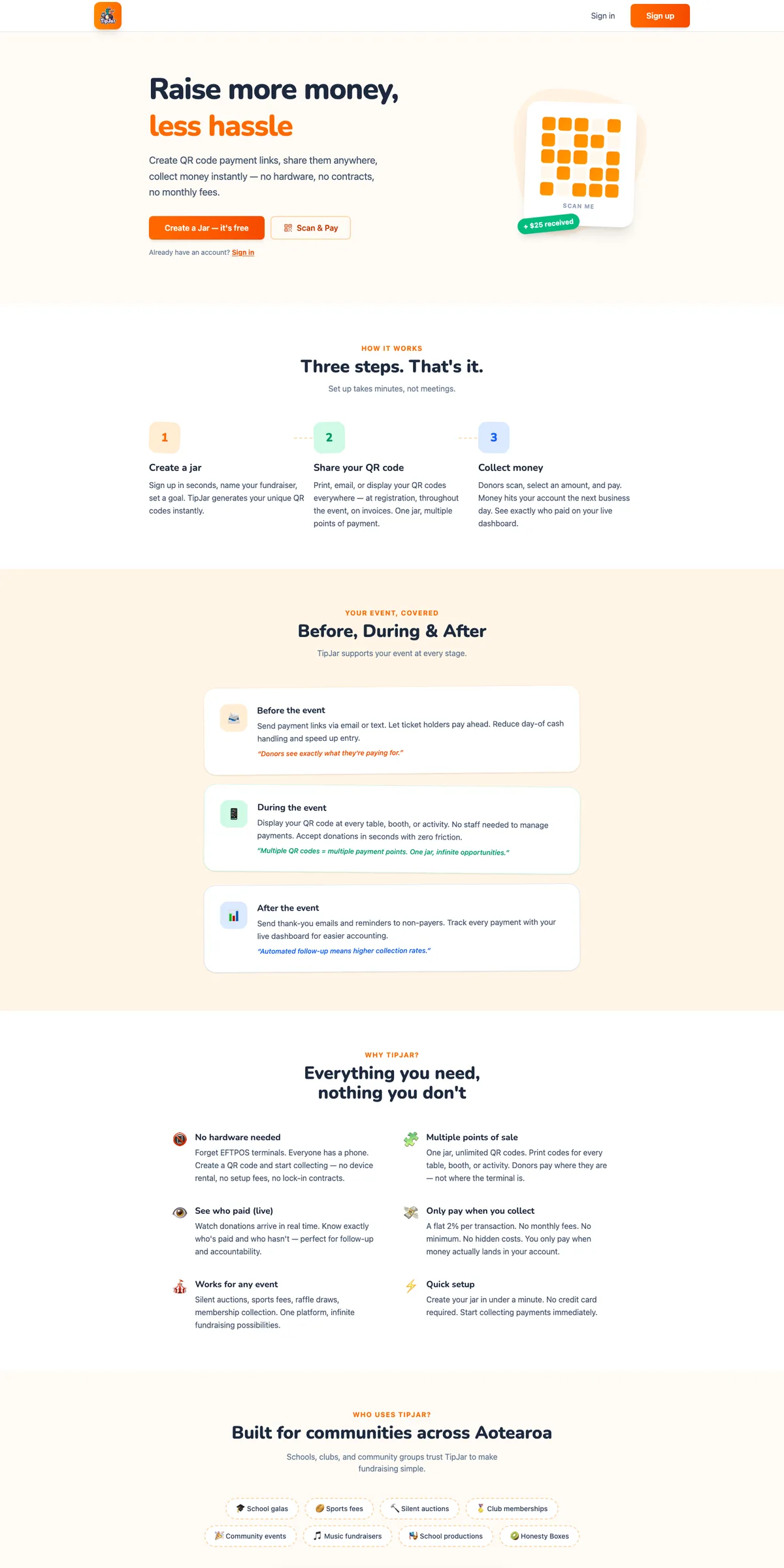


TipJar.nz is a simple digital payments platform for schools, clubs and community groups across Aotearoa; think Eftpos without the terminal. You create a "Jar", generate QR codes and payment links, share them around an event, and see donations arrive on a live dashboard. We shipped a production MVP in six weeks to prove the concept, and the project was later picked by Venture Taranaki and presented at a public Showcase in May 2026.
What we set out to prove
For an Minimum Viable Product we had three clear goals:
- Remove barriers to entry: no hardware, no long contracts, no complex setup.
- Enable multiple payment points from one fundraiser.
- Keep compliance and risk small so we could launch quickly and safely.
Six-week plan
We organised the process into weekly deliverables so we could show working software fast and iterate with real users.
- Week 1: Product & design: Define and design core functionality: create Jar, generate QR, pay, dashboard.
- Week 2: Payments integration: Integrate a card processor and ensure that payment flow was possible and reliable.
- Week 3: Core backend: Users, Jars, QR records, Payers, Payouts and Email notifications.
- Week 4: Frontend & QR generation: Public payment pages, QR code generation (SVG/PNG), printable assets and share links.
- Week 5: Dashboard & live updates: Payment status, subscriptions, basic accounting export and live updates for events.
- Week 6: Testing & launch: Staging testing, onboarding a handful of local groups, fix feedback, deploy and public launch.
Technical architecture
We made pragmatic choices to reduce build time, keep costs low and leave room to scale later.
- Frontend: Simple is better, no fancy effects and a structure that is proven to work well for mobile phones and desktop.
- Backend: All our projects are built in Ruby on Rails, famous for being the choice for startups that require speed and reliability.
- Payments: We used Stripe, a worldwide payment processor for secure card handling and payouts.
- QR codes & links: Each Jar has a unique public URL. We generate QR codes for the jar URL and optionally append location or point‑of‑sale parameters so organisers can track which QR code was used.
- Hosting & deployment: The site is hosted in Sydney in AWS, we plan to move it to New Zealand early 2027.
UX and product choices that mattered
- One Jar, many QR codes: A Jar represents an organisation. You can print a QR for each event, booth or activity but all payments map back to the same Jar.
- Fast setup: Create a Jar in under a minute, no credit card for signup. Reducing friction was essential for adoption by volunteer organisers.
- Transparency: Live donor list and the ability to export transactions made it easier for treasurers to reconcile and for organisers to follow up.
- Share options: QR for print, short links for SMS/email, and copyable payment links for social channels.
Testing, launch and early validation
The project was selected by Venture Taranaki as a promising local initiative, and we presented TipJar.nz at a public Showcase in May 2026. That public demo was useful for getting feedback from other community organisations and potential partners.
What we learned
- Start narrow: Solve one problem very well. For us that meant focusing on fast QR payments before adding subscriptions, fundraising tiers, payer profiles.
- Track everything: Recording where payments come from (which QR) and why (payment metadata) powers follow‑up and improves collection rates.
- Design simple: Simple language, minimal setup and printable assets matter. Many organisers are time‑poor and tech‑light.
- Iterate with real users: Run a few real events before a big public launch to find edge cases in reconciling fees, refunds and disputed charges.
Next steps
For TipJar.nz the next phases are improving onboarding, adding better reporting for treasurers, and adding integrations with common accounting tools. We’ll keep iterating based on feedback from clubs and schools across Aotearoa. We are seeing Jars being opened all round New Zealand for different purposes.
If you want to try it, visit tipjar.nz or get in touch for a 15‑minute walkthrough. If you’re a developer or organisation planning a similar MVP and want the technical notes or schema we used, get in touch.